Process Philosophy
Process philosophy rejects the classical metaphysical picture in which reality consists of static entities with intrinsic properties. Instead, it proposes that becoming, transformation, and relational structure are fundamental—that what we call "things" are better understood as crystallized patterns within continuous process. This research program applies process-philosophical methods to three domains where traditional metaphysics has reached an impasse: the nature of identity, the philosophy of mind, and the foundations of quantum mechanics.
The core insight uniting this program is grammatical: we have mistaken the products of our conceptual categories for features of reality. When we nominalize a verb (treating "to be conscious" as naming the thing "consciousness," or treating "identical" as naming a primitive property "identity"), we create the illusion of objects where only relations and transitions exist. By returning to process—to the activities, distinctions, and transformations that ground our concepts—we dissolve rather than solve traditional philosophical puzzles.
This program demonstrates that process philosophy is not mere metaphorical speculation but a rigorous analytical framework with formal mathematical expression (Homotopy Type Theory), logical power (the Trident dialectical method), and explanatory reach across domains usually treated as separate. The payoff is intellectual economy: when we stop reifying our concepts, entire categories of pseudo-problems evaporate.
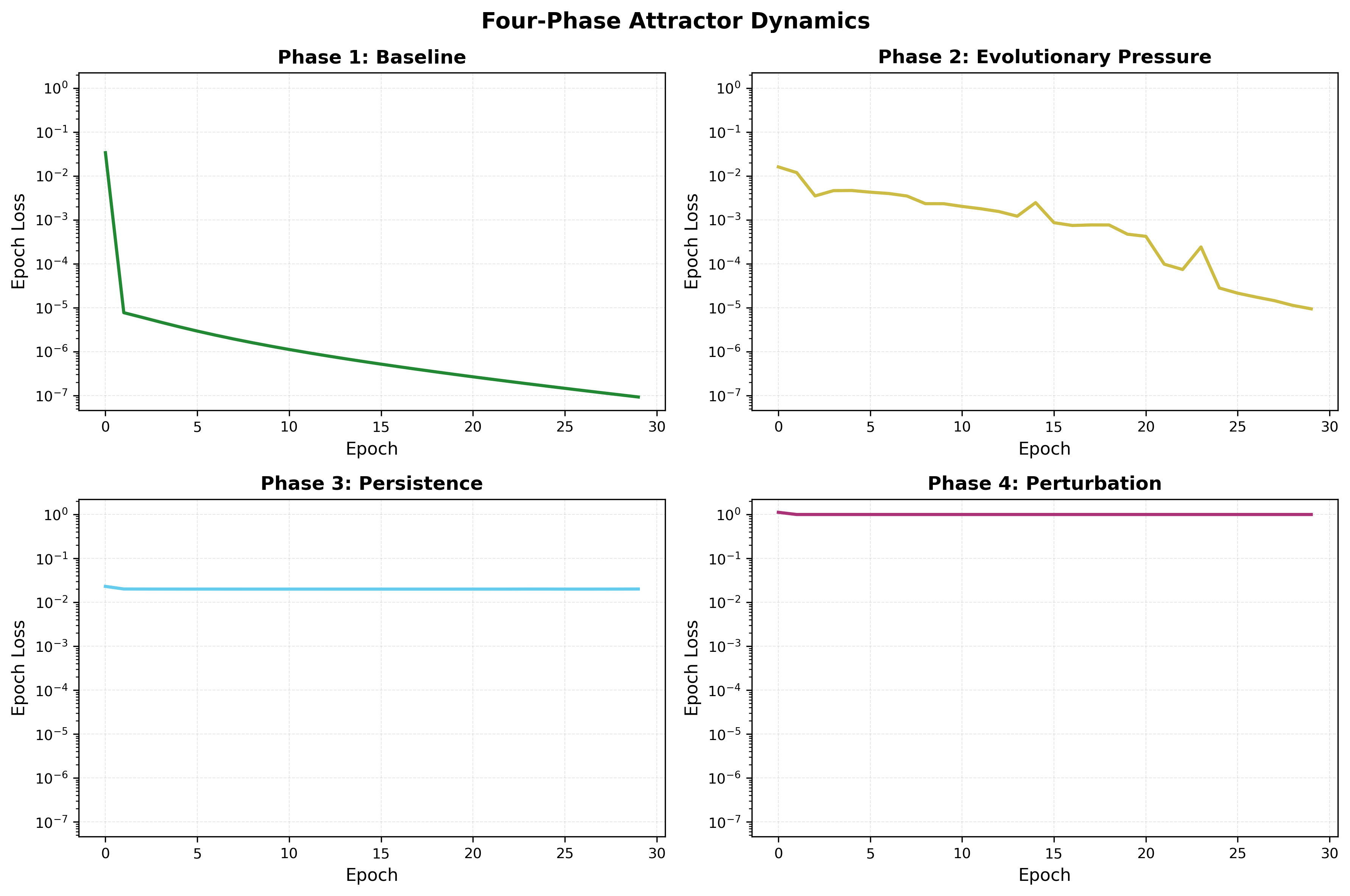
Attractor dynamics in relational networks: computational modeling shows how consciousness-like phenomena emerge from deterministic network processes.
Research Questions
- Is identity primitive or derivative? Can the law of identity (A=A) be grounded in something more fundamental than self-relation? What does it mean to say "identity is structural equivalence"?
- Why does consciousness seem metaphysically harder? Is the "hard problem" a genuine feature of consciousness, or an artifact of treating a process-verb as if it named a substance-noun?
- How can we systematically dissolve philosophical claims? What logical methods can expose hidden assumptions, contradictions, or vacuities in major philosophical positions?
- Does quantum indeterminacy reflect reality or epistemic position? If the universe is a static four-dimensional block, how does our traversal through it generate the appearance of probabilistic collapse?
- What remains after eliminativism? If phenomenal experience is not irreducible, how do we account for the persistent intuition that there's "something it is like" to see red?
Papers in This Program
Identity is Irreducibly Relational
Challenges the foundational status of the law of identity by demonstrating that A=A presupposes A is already defined—and definition requires distinction. Argues that Homotopy Type Theory and the Univalence Axiom vindicate this process-philosophical view: identity emerges from structural equivalence rather than existing as a primitive metaphysical property.
The Temporal Bitmap Interpretation of Quantum Mechanics
Proposes a realist account that dissolves the measurement problem without non-determinism or consciousness-dependent collapse. The universe is a four-dimensional block; what we perceive as wave function dynamics are artifacts of our epistemic position traversing this structure. Measurement is trajectory selection, not ontological creation.
Replication Optimization at Scale: Dissolving Qualia33k words
Comprehensive monograph arguing for eliminative materialism regarding phenomenal consciousness. Drawing on Gödelian self-reference, relational functionalism, and network epistemology simulations, demonstrates that qualia are best understood as computational artifacts—the format in which the brain represents information—rather than irreducible intrinsic properties.
Methodological Approach
Grammatical Therapy
Wittgenstein/Ryle: Diagnose puzzles as conceptual confusions from language misuse. Dissolve problems by clarifying grammar of key terms.
Homotopy Type Theory
Formal mathematics grounding process insights. The Univalence Axiom treats propositional equality as isomorphism—identity as structural equivalence.
Dialectical Logic
The Trident systematizes trilemmatic method for exposing hidden assumptions through forced choice: incoherence, contradiction, or vacuity.
Computational Modeling
Large-scale network simulations demonstrating how consciousness-like phenomena emerge from deterministic relational networks without requiring irreducible qualia.
Throughline
These papers form a dialectical spiral: Identity establishes that identity is derivative, not primitive—creating space for non-essentialist metaphysics. Temporal Bitmap applies these insights to quantum mechanics, showing apparent indeterminacy is also an epistemic artifact. The Monograph synthesizes everything into comprehensive eliminativism: if identity is relational, consciousness's apparent intrinsic nature is grammatical confusion rather than metaphysical fact.
The unifying theme: what appears to be metaphysical necessity dissolves into grammatical and epistemic artifacts once we adopt a process-relational framework. Reality is not a collection of things with intrinsic properties—it's a continuously transforming network of relations.
Explore the Archive
Access all working papers and preprints in this collection.